
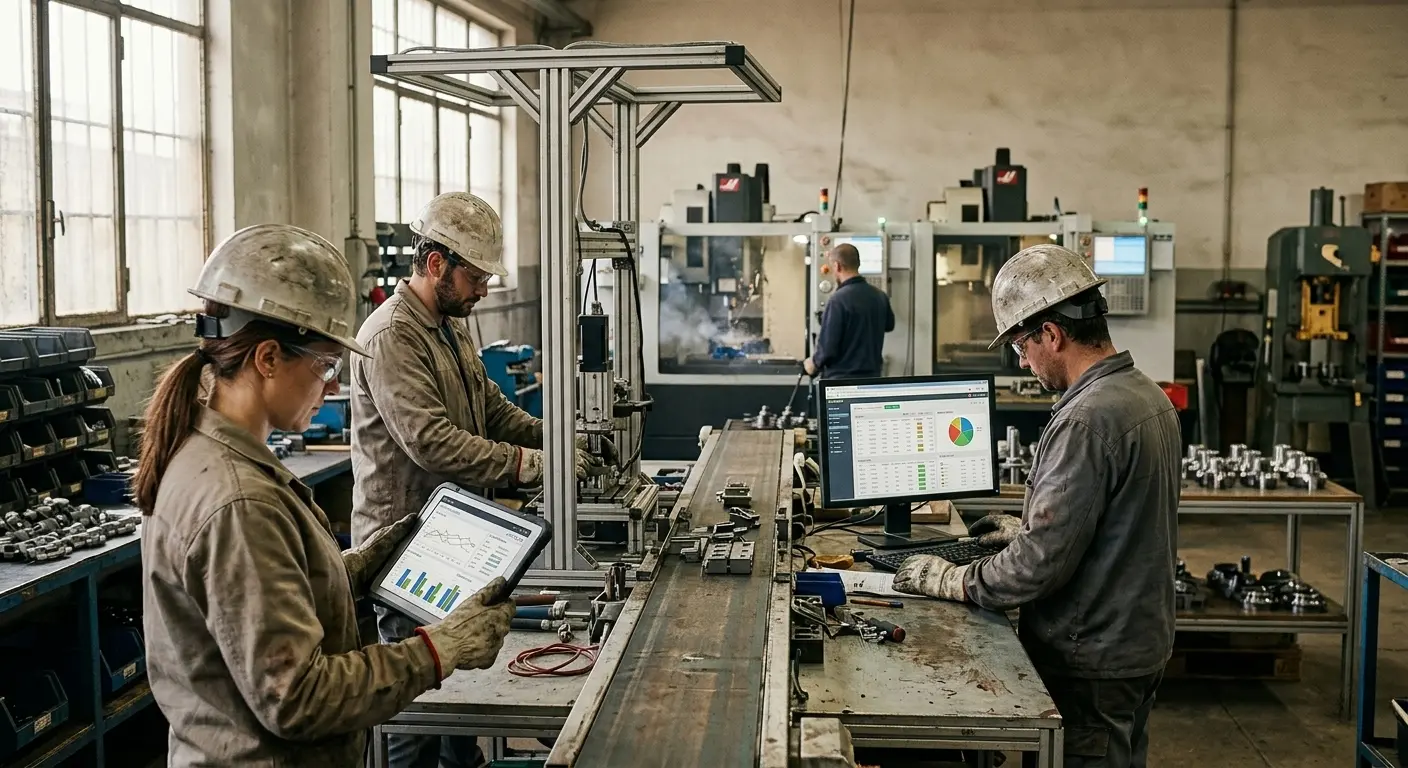
The Manufacturing Ceiling: A CEO’s Perspective on Scaling in 2026
By Richard Paterno, CEO of Blue Sky Consulting
In the world of manufacturing, growth is a double-edged sword. As a CEO, I’ve seen it time and again: a company lands a major contract, orders surge, and the team is energized. But within weeks, the cracks begin to show. Inventory counts drift, production schedules become “best guesses,” and the finance team is buried under a mountain of conflicting spreadsheets.
This is what I call the Manufacturing Ceiling. It’s the point where your manual processes can no longer support your operational reality. In 2026, the complexity of the global supply chain and the rising cost of labor mean you can no longer afford to operate in the dark.
At Blue Sky Consulting, we don’t just implement software; we help manufacturers break through that ceiling. We focus exclusively on the two platforms that I believe offer the best path to digital maturity: Microsoft Dynamics 365 Business Central and Odoo.
Why 2026 Demands a Strategic ERP Shift
The days of “good enough” data are over. To remain competitive today, your leadership team needs real-time visibility into every corner of the shop floor. An ERP is the bridge between your high-level strategy and your daily production.
For a manufacturing CEO or COO, the right system provides three essential pillars:
-
Unified Operations: You cannot scale a business built on “data silos.” When sales, procurement, and production are all using the same platform, you eliminate the friction that leads to missed deliveries.
-
Precision in MRP: Material Requirements Planning (MRP) is the heartbeat of your plant. A modern ERP automates these calculations, ensuring you have the right components at the right time without over-leveraging your cash in excess inventory.
-
True Costing: Spreadsheets rarely account for the full reality of labor, overhead, and scrap. A centralized system provides the granular COGS (Cost of Goods Sold) data required to protect your margins.
Selecting Your Engine: Business Central vs. Odoo
In my experience, the choice often comes down to your organization’s technical DNA and growth strategy.
Microsoft Dynamics 365 Business Central: The Enterprise Standard
If your organization is looking for a “forever” system with deep financial rigor, Business Central (BC) is often the winner. As part of the Microsoft ecosystem, it offers a level of security and interoperability that is difficult to beat.
-
Integrated Intelligence: Business Central leverages AI-driven forecasting to predict stock-outs before they happen.
-
Deep Production Logic: For manufacturers with complex assemblies and multi-level Bills of Materials (BOMs), BC provides the structured control necessary for high-compliance environments.
-
The Microsoft Edge: Your team already knows how to use Outlook, Excel, and Teams. Business Central pulls all of that together, allowing your staff to stay productive in a familiar environment.
Odoo: The Agile Challenger
For manufacturers who value speed, flexibility, and a modern user experience, Odoo has become a powerhouse in 2026. Its modular design is perfect for companies that want to start lean and grow fast.
-
Work-Center Efficiency: Odoo’s tablet-friendly shop floor interface allows operators to log time, check instructions, and report quality issues with a single tap.
-
Modular Scalability: You only pay for what you use. Start with Inventory and Manufacturing, then add Maintenance, Quality, or PLM as your shop floor becomes more sophisticated.
-
Total Visibility: Odoo’s dashboarding provides at-a-glance views of machine uptime and work-order status, giving your managers the clarity they need to pivot mid-shift if necessary.
Industry Nuance: Discrete vs. Process
One of the biggest mistakes a firm can make is choosing an ERP that doesn’t “speak” their manufacturing language.
-
Discrete Manufacturing: If you are assembling parts—think machinery, electronics, or equipment—you need the robust routing and scheduling found in both Odoo and BC.
-
Process Manufacturing: If you deal with formulas and batches—such as in the energy or food sectors—traceability is your highest priority. We specialize in configuring these systems to ensure full lot-tracking and regulatory compliance from raw material to finished product.
The Blue Sky Methodology: Beyond the Go-Live
I’ve spent 20 years in this industry, and I’ve learned that a failed ERP implementation is rarely the software’s fault. It’s almost always a failure of process and people.
When you work with Blue Sky Consulting, we take a “Business-First” approach:
-
Diagnostic Audit: We don’t start with a demo; we start with your pain points. We find the inefficiencies that are currently costing you money.
-
Clean Migration: We ensure your legacy data is scrubbed and structured before it ever touches the new system.
-
Active Adoption: We spend significant time on the shop floor and in the back office, ensuring your team is confident and capable on day one.
Conclusion: Leadership in the Digital Age
An ERP implementation is not an IT expense; it is a strategic investment in your company’s future. It is the tool that allows you, as a leader, to move from reactive firefighting to proactive growth.
Whether the enterprise power of Microsoft Dynamics 365 Business Central or the agile flexibility of Odoo is the right fit for your plant, my team at Blue Sky Consulting is ready to lead the way.
Richard Paterno – CEO, Blue Sky Consulting
FAQ: Manufacturing ERP in 2026
Which system is better for a small shop? Odoo often wins for smaller shops due to its lower entry cost and modularity. However, if you are already heavily invested in the Microsoft stack (and use Excel for everything), Business Central may offer a smoother transition.
Can we handle multi-level BOMs in these systems? Yes. Both Business Central and Odoo are fully capable of handling complex, multi-level Bills of Materials and sophisticated production routings.
How does Blue Sky speed up ROI? By focusing on “Time to Value.” We use pre-configured templates specifically designed for manufacturing workflows, which avoids the long, expensive custom coding phases that plague traditional implementations.