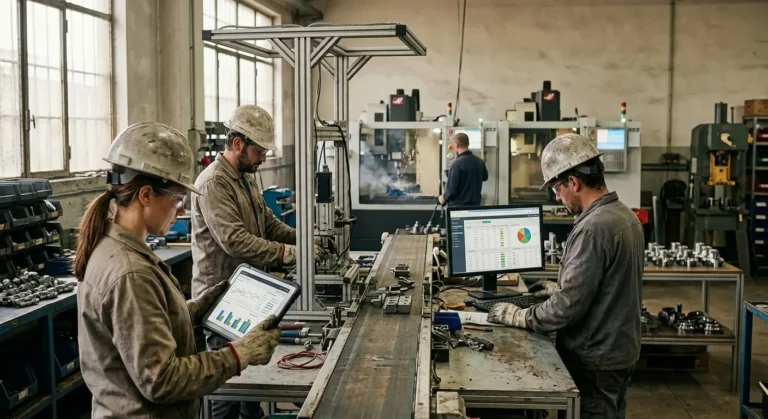

How ERP Systems in Manufacturing Improve Efficiency
Production lines are being run, orders are being received, and the inventory numbers are not matched by what is actually on the floor. Orders are being placed by the procurement team based on outdated data, and reports that should have been ready days ago are still being waited on by the finance team.
Many manufacturing leaders go through it daily across Alberta and beyond.
When growth is being slowed down by manual processes and disconnected systems, a smarter solution is called for. That solution is an ERP for manufacturing, a system built to bring order, visibility, and control back to the production floor.
How ERP Systems in Manufacturing Improve Efficiency
A lot of moving parts are dealt with by manufacturing businesses. There is production scheduling, inventory management, procurement, order management, and quality control. When these functions are operated in silos, mistakes are inevitably made.
All of these functions are connected to one centralized platform by a manufacturing ERP system. The same data is worked on by every team, from operations to finance. Errors are reduced this way, and decision-making is sped up across the board.
A measurable improvement in manufacturing efficiency is produced as a result, along with a significant drop in operational costs.
What is an ERP System in Manufacturing?
ERP stands for Enterprise Resource Planning. In simple terms, it is a software platform through which every part of a manufacturing business is connected into one system.
It acts as a central nervous system for the business. Information is sent and received by every department through the same platform, so nothing gets lost and nothing gets duplicated.
A manufacturing enterprise resource planning system is specifically designed to handle the unique demands of production environments. Raw materials are tracked, production schedules are managed, machine usage is monitored, and orders are ensured to ship on time.
Real-time visibility into every corner of the business is given to operations managers and directors by ERP software for manufacturers. Software like Microsoft Dynamics 365 and Odoo is built to handle these exact challenges.
How to Know When the Business is Ready for an ERP System
Not every business needs an ERP system from day one. Here are clear signs that the time has come:
- Inventory errors are causing production delays or customer complaints
- The finance team spends too much time manually reconciling data
- Production scheduling is done through spreadsheets or disconnected tools
- Real-time data tracking is not possible because information lives in multiple systems
- Scaling is being held back by process bottlenecks
When two or more of these problems are showing up regularly, investing in an ERP system for production management becomes less of a choice and more of a necessity.
ERP Benefits for Manufacturing
The benefits of ERP for manufacturing go far beyond just organizing data. Here is what a well-implemented system delivers:
Optimize Stock Levels
One of the biggest wins with ERP software in manufacturing is smarter inventory management. Stock levels are tracked by the system, so production teams always know what is available and what needs to be ordered.
There is no over-purchasing or scrambling when materials run low. Resource optimization becomes much easier when accurate and up-to-date data is made available.
Reduce Carrying Costs
Excess inventory is expensive. It ties up capital, takes up warehouse space, and increases the risk of waste. A manufacturing process ERP system helps businesses order exactly what they need — reducing carrying costs and improving cost management across the supply chain.
Prevent Stockouts or Overstock Situations
Stockouts stop production. Overstock drains cash flow. An ERP in manufacturing operations uses historical data and production schedules to forecast demand accurately, preventing both situations before they happen.
Is your team still struggling with disconnected systems and outdated data? Connect with Blue Sky Consulting to see how a centralized manufacturing system can streamline your workflows and boost your bottom-line efficiency.
Conclusion
Manufacturing businesses in Alberta and across North America all face the same core challenge. When the demand grows, the systems fail to deliver consistent results. It happens because the systems were never built to keep up.
A properly implemented ERP for manufacturing changes that. It brings together all the factors that run the business into one platform.
Blue Sky Consulting helps Alberta-based businesses in energy, manufacturing, construction, and engineering to implement the right ERP system, with proven expertise in both Microsoft Dynamics and Odoo.
Frequently Asked Questions
What is ERP in manufacturing?
ERP in manufacturing is a software system that connects all the business operations in one place. It gives the teams real-time visibility across all operations.
What are the main benefits of ERP for manufacturing companies?
The key benefits include improved inventory accuracy, reduced carrying costs, better production scheduling, stronger order management, and measurable gains in manufacturing efficiency.
Is ERP suitable for small manufacturers?
Absolutely. ERP for small manufacturers is available through platforms like Odoo and Microsoft Dynamics 365 Business Central, both of which are scalable and cost-effective for growing businesses.
How long does a manufacturing ERP implementation take?
Timelines are varied based on business size and complexity. A few months are taken by a basic implementation, while six months or longer may be taken by more complex deployments. The timeline is shortened when experienced consultants are partnered with.
What is the difference between ERP and MES?
The broader business operations, finance, and supply chain are all handled by ERP. The production floor is particularly focused on Manufacturing Execution Systems (MES). MES capabilities are included in many modern ERP platforms.